





 MTA32ATF4G64HZ-2G6B2 SODIMM DDR4 MICROM
- DDR
- GDDR
- LPDDR
- FLASH
- eMMC
- MCP
- eMCP
- RLDRAM
- UFS
- HBM
- SSD
- RAM
- HDD
- CPU
- GPU
- Wafer
- GPU server
- HOT OFFER
-
OTHER
- MCU
- XILINX
- INTEL
-
TI
- interface
- PMIC-Regulator-Linear
- Data Acquisition - Digital to Analog Converter ADC
- Linear Devices - Amplifiers
- Linear Devices - Voltage Regulators
- MCU
- switch controller
- power management
- DC converter
- voltage reference
- Comparators
- converter
- SENSOR
- driver
- monitor
- LED driver
- logic-signal switch
- Distribution switch
- grid inverter
- OTHER
- SENSOR
-
ONSEMI
- MOSFET
- Schottky diodes
- Rectifier
- AC-DC controller and regulator
- ESD diode
- LED driver
- Optocoupler-phototransistor output
- Monitor and reset the chip
- Switching diode
- Fast recovery/ultrafast recovery diode
- Logic gate
- Transistor
- General purpose diode
- Zener diode
- Linear regulator
- Operational Amplifier
- Gate drive IC
- OTHER
- infineon
- ADI
- ISSI
- MAXIM
- TOSHIBA
- CYPRESS
- NIC
- memory
- Switch

PHONE:+8619166208396
e-mail:3628728973@qq.com

Similar product

Product Detail
产品详情
| 脚位/封装 | TSOP-48 |
| 外包装 | |
| 无铅/环保 | 无铅/环保 |
| 电压(伏) | 3.3 V |
| 温度规格 | 0° ~ 70°C |
| 速度 | 1 MHZ |
| 标准包装数量 | 1000 |
| 标准外箱 | |
| Number Of Words | 2G |
| Bit Organization | x8 |
| Density | 16G |
| Features | Polyimide (if applicable) |
| Package | TSOP I(48-pin CPL version) |
| Generation Feature Set | 3rd set of device features (rev only if different) |
| Speed Grade | Async only |
| Design Revision | C |
| Classification | 1-1-1-1 (Die-nCE-RnB-IO Channels) |
| Level | SLC |
| Production Status | Production |
| Package Material | Pb-free |
| Interface | Async only |
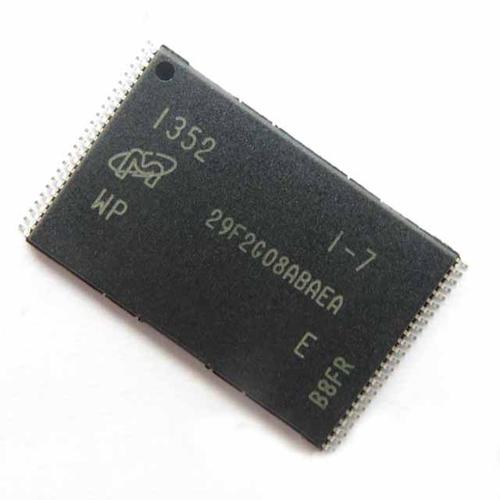
General Description Micron NAND Flash devices include an asynchronous data interface for high-performance I/O operations. These devices use a highly multiplexed 8-bit bus (I/Ox) to transfer commands, address, and data. There are five control signals used to implement the asynchronous data interface: CE#, CLE, ALE, WE#, and RE#. Additional signals control hardware write protection and monitor device status (R/B#). This hardware interface creates a low pin-count device with a standard pinout that remains the same from one density to another, enabling future upgrades to higher densities with no board redesign. A target is the unit of memory accessed by a chip enable signal. A target contains one or more NAND Flash die. A NAND Flash die is the minimum unit that can independently execute commands and report status. A NAND Flash die, in the ONFI specification, is referred to as a logical unit (LUN). There is at least one NAND Flash die per chip enable signal. For further details, see Device and Array Organization.
RECOMMEND
Hot product




QQ online chatwork:Mon to Fir 9:30am-18:30pm
Please select the following customer service online communication:


Scan QR code and add customer